Q&A with Vincent Wargnier on winning the Higgs Realtime Hackathon
The Boson AI TeamOctober 2, 2026
Compass concept film, made by the Compass team.
Vincent Wargnier and Nayl Ahmadulin met for the first time just five days before Boson AI’s recent Higgs Realtime Hackathon in San Francisco. They teamed up, shipped Compass together and took first place with a voice agent that keeps talking while it searches and works in the background, instead of going quiet.
Compass can search, reason and run heavy tasks in the background — such as building a website — while keeping the conversation fluid, asking questions and understanding you better as the results come in.
We sat down with Vincent, who also runs Magif.ai, an agent-builder startup used mainly for AI coaching, after the event to ask about his experience building with Higgs Realtime.
Congratulations on taking home the top prize in our recent Higgs Realtime Hackathon. Can you tell us in one sentence, what is Compass, and who is it for?
The Compass concept is an AI agent that feels like talking to a human, while still leveraging the best agentic capabilities we have today: tool calling, heavy background tasks, web searches, building things, etc. Everything happens through a fully natural, human-like conversation.
Is this something that you think could compete with the Squarespaces of the world? Do you know of any other website builders that are incorporating voice commands?
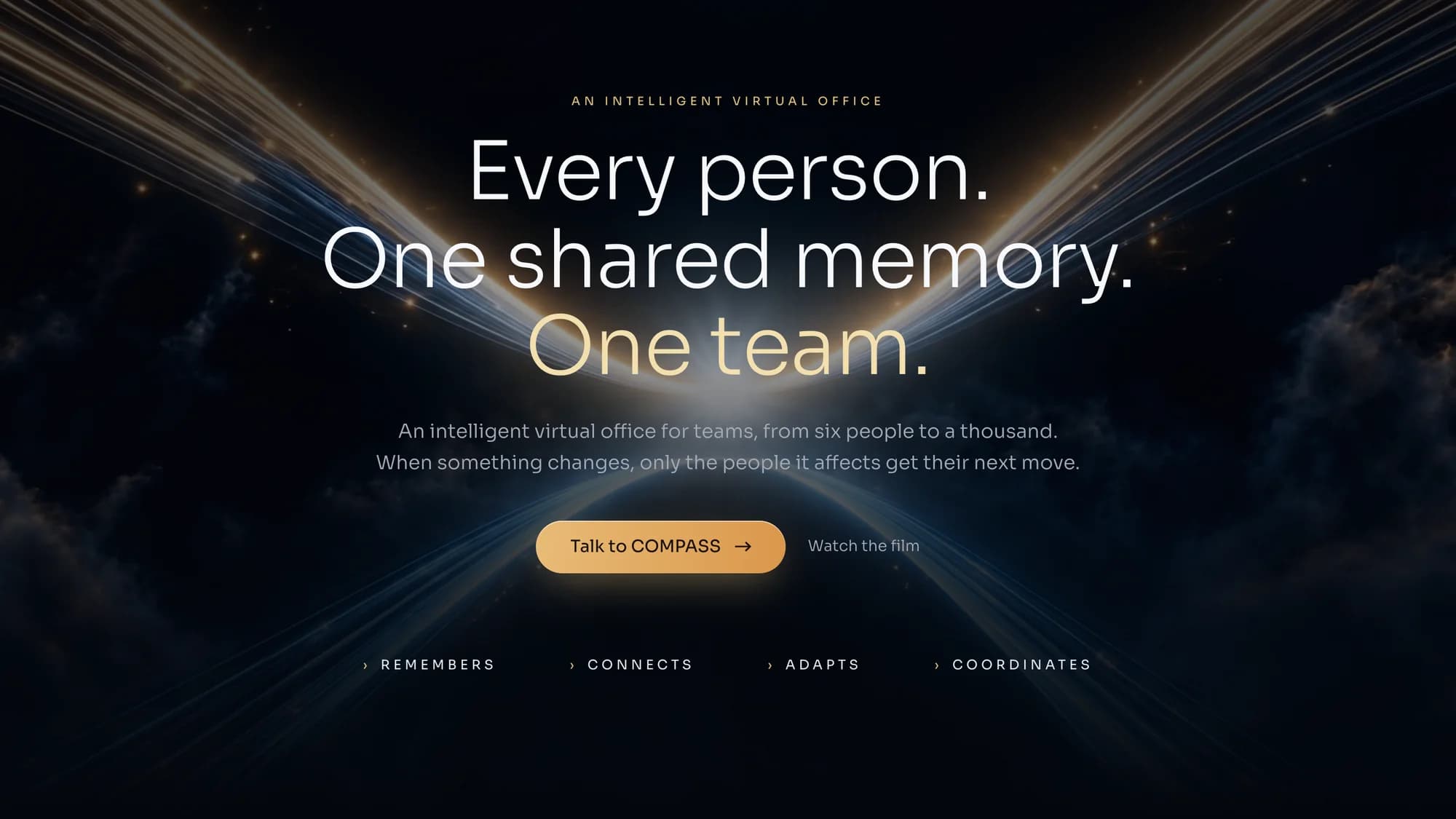
The Compass home page. Image: Compass.
I think it could compete with the Squarespaces of the world in some ways, but I don't really see Compass as a website builder specifically. Building a website was more of an example of what a useful agent should be able to do.
I don't know any service today that provides a voice agent experience I find really satisfying. In terms of human-like conversation, I think OpenAI is probably the best today, but after five minutes of discussion I often feel like I'm getting AI slop directly into my ears, without enough actual value being created.
What interests me is: can I talk naturally to an agent AND have it actually do useful work at the same time?
Walk us through a real Compass conversation. What is the user asking for, what's running in the background, and what is Compass saying to them while that happens?
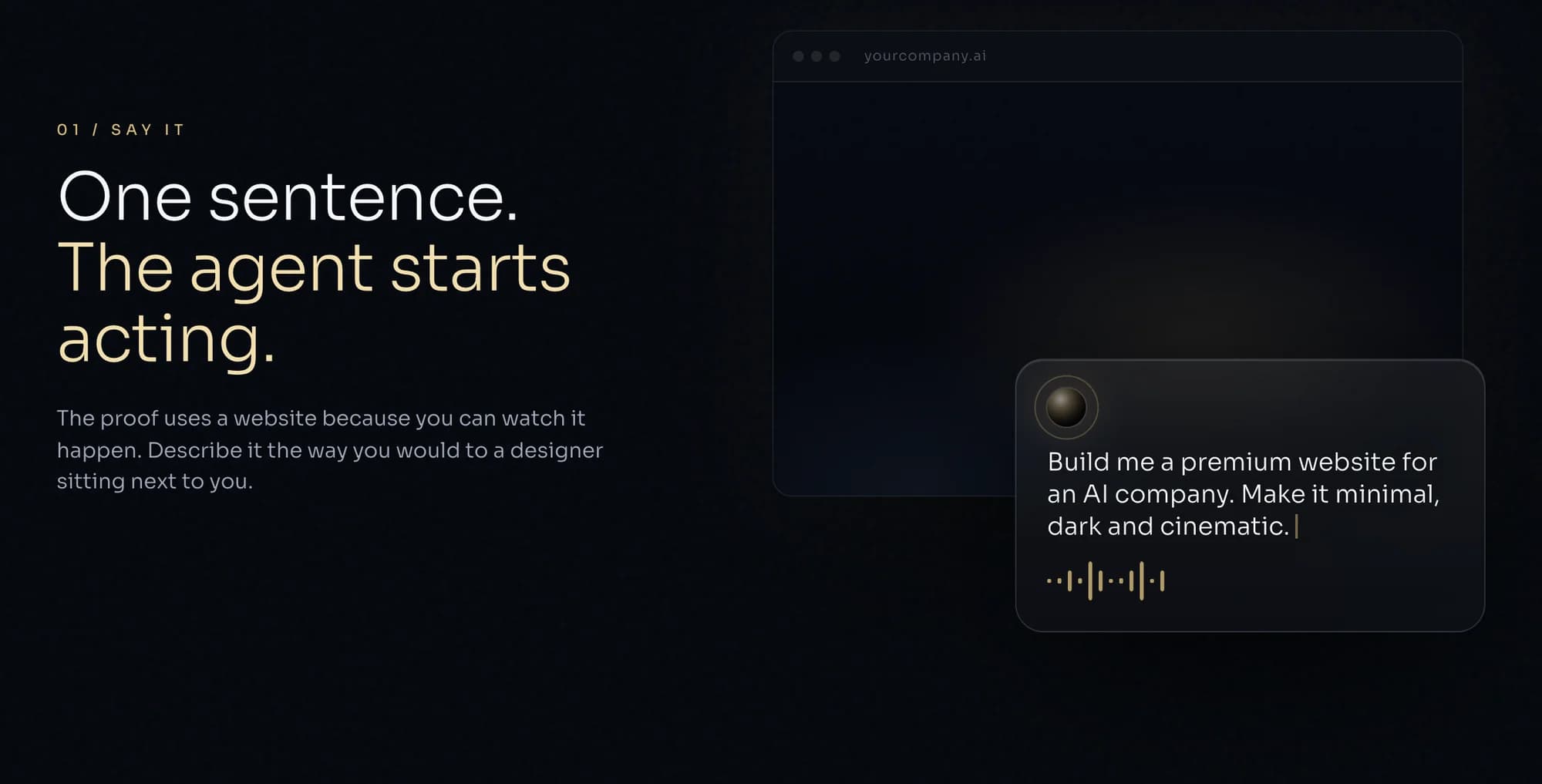
A Compass conversation starts from one spoken sentence. Image: Compass.
A user could ask Compass:
UserHey, can you build me a real quick webpage for my presentation tomorrow, so I can give my clients a way, propose my clients to follow up with me after the presentation? And also check where I can park tomorrow for the event, and how early I should leave my place.
Compass could say:
CompassSure, I'm doing it.
At this point it starts the website-building tool and starts checking the event/parking/maps in the background.
But instead of going silent, it keeps the conversation alive:
CompassBy the way, how should the website look? Same colors as your brand, or something specific? And for tomorrow, you're leaving from your house, right?
Basically, the agent keeps talking and asks useful questions that can improve the final results of the tools, and also lets the tools run so that hopefully some results can come back while chatting, before the conversation ends.
Then at some point a tool returns a first result. If, in the meantime, the user added a new specification, the agent can trigger an update to the website, another search, or whatever tool is necessary.
And depending on where the conversation is going, the agent can keep asking questions, talk about something else, or simply end the conversation while background tasks are still finishing.
Basically, like a human would do.
ConversationIn the background
User“Can you build me a quick webpage for my presentation tomorrow? And check where I can park, and how early I should leave.”
—
Compass“Sure, I'm doing it.”
In the background
Website builderstartsParking and routestarts
Compass“By the way, how should the website look? Same colors as your brand, or something specific? And for tomorrow, you're leaving from your house, right?”
In the background
Website builderrunningParking and routerunning
UserAnswers, and adds a new detail for the site.
In the background
Parking and routeresult backWebsite builderrunning
CompassFolds the first result into its next sentence and sends the new detail to the website builder.
In the background
Website builderrunning
CompassKeeps talking, changes the subject, or ends the call while the work finishes.
In the background
Website builderfinishing
A Compass conversation, as Vincent describes it. Quoted lines are his examples; the rest is paraphrase.
Your social post on winning says voice agents “shouldn't stop talking when they start working.” What's broken about how voice agents typically handle long-running tasks today?
I think today most voice agents are still pretty dumb and not that useful.
My idea is not to build a voice agent just so we can say “look, you can talk to an AI.”
I want to take a normal, actually useful agent — with tools, reasoning, background tasks, etc. — and turn that into a voice agent.
Today, when voice agents launch a long-running task, they often either go silent, say “please wait,” or give you useless status updates.
I think that's the broken part.
“Don't hide latency, use it” flips the usual goal on its head. Where did that come from — did the idea come first, or did you find it while building?
Instead of having the agent say “tool running… wait…” I think the agent should remain proactive and useful while things are running in the background.
That’s actually the same type of logic I use for the agent builder in my startup, Magif.ai.
Concerning voice agents, I think it's the same principle: keep the agent proactive, ask useful questions when it makes sense, or stop talking if not talking is actually the best thing to do.
But don't force the conversation to stop just because a tool is running.
The hackathon made me realize that this principle is probably even more important for voice, because silence feels much more awkward in a live conversation than in a text chat.
Is there anything about Higgs Realtime in particular that you think made it an ideal model for what you're building? Was it the listen-while-talking behavior, the tool calling mid-sentence, or something else?
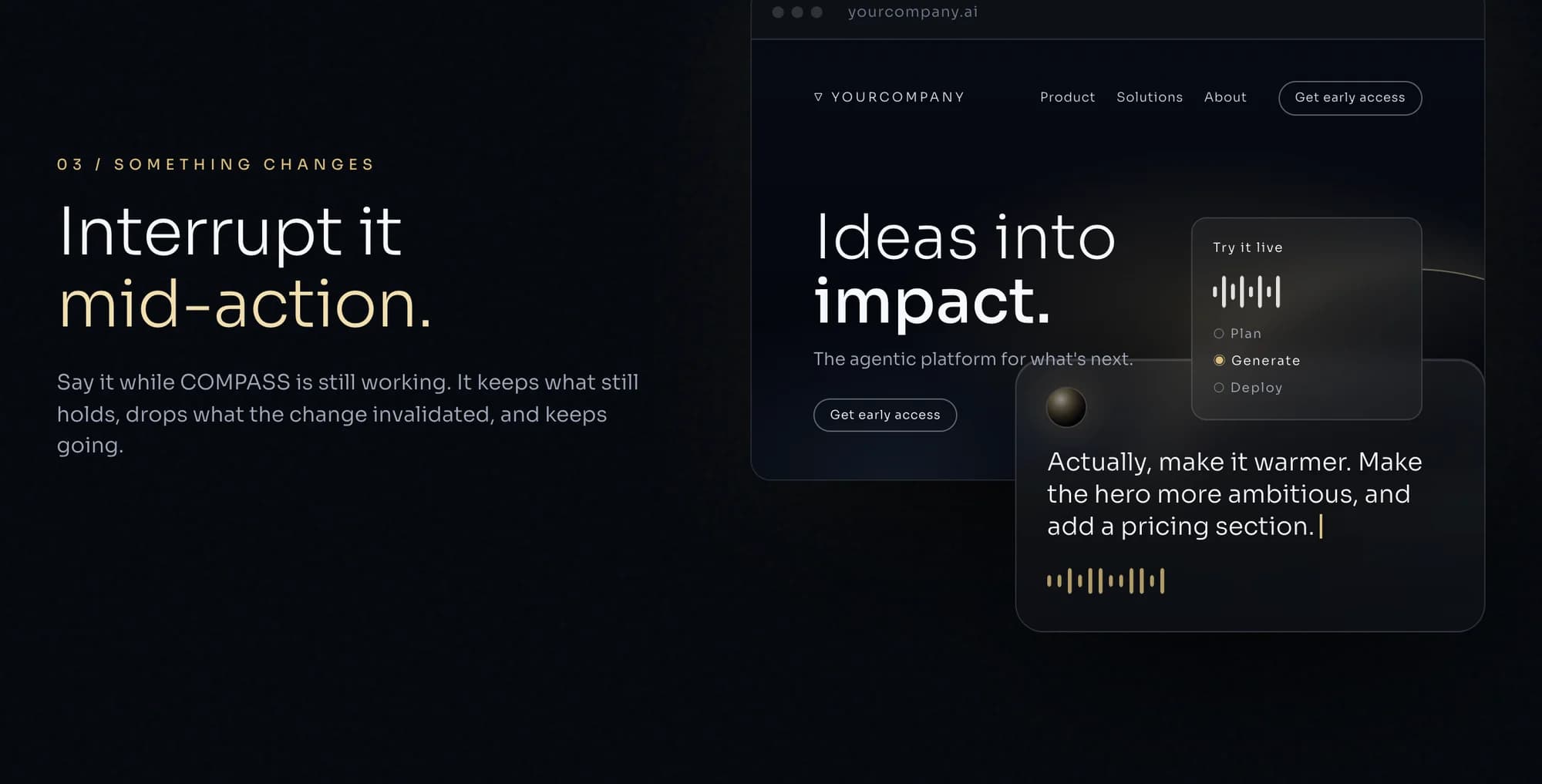
Speaking to Compass while it is still building. Image: Compass.
For me, the key element is the ability to call tools mid-sentence, while the conversation is happening. That's exactly where a voice agent can start becoming as useful as a classic agent while still being voice-first. You don't want the agent to finish a 30-second speech before it starts doing the actual work. Speech and action should happen at the same time.
What surprised you about the model?
What surprised me first is honestly how easy it was to integrate.
I asked Claude to implement Higgs through the API, and it basically worked right away. I didn't even really open your website except to get the API key, haha.
And more seriously, I was surprised that we could get this type of real-time behavior working quickly enough during a one-day hackathon. Usually voice integrations can become messy very fast.
How do the background results get fed back into a live conversation without making it feel jumpy? (Commenters on your LinkedIn post asked this too.)
The way I see it, a voice agent doesn't need to generate one giant response at once.
It can think about the next phrase, or next few words, while continuously checking the status of everything happening in the background.
The simplest mental model I have is: imagine someone on the phone with you, typing on their keyboard and using their computer while still talking to you naturally.
Maybe they are checking your appointment, filling out a form, searching for something, etc. They don't suddenly become silent for 30 seconds every time they click something.
That's how I imagine the future of useful voice agents.
When one background task returns a result, that information can naturally become part of the next thing the agent says, instead of feeling like a completely separate interaction.
Where do you think voice agents will be in 12 months, and what has to change for them to feel more like talking to a person?
Where Compass is heading: a virtual office that routes a change to only the people it affects. A scripted concept with a fictional team. Image: Compass.
I've been doing hackathons in SF for more than two years now, and I've seen a lot of improvements in the agentic space. But what shocked me is that any time an event is about voice agents, I often feel like we're still in almost the same state as two years ago.
The biggest improvement I've seen is how OpenAI improved the human-like feeling with ChatGPT voice.
But I still feel there is a big gap between “sounds human” and “is actually useful.” My dream would basically be to talk to an AI with the naturalness of the best voice models, while behind it you have something like GPT-5-level reasoning and full agentic capabilities running.
I don't want to choose between a smart agent and a natural voice agent. I want both.
For developers: what's the one piece of advice you'd give someone building their first real-time voice app on Higgs Realtime this week?
I think today anyone can probably build a basic voice agent with Higgs and Claude CLI without having very special skills.
But if someone wants to innovate, my advice would be:
Don't think “how do I build a voice interface?” Think about how a real human conversation works. A human can talk, think, search, type, remember something, change direction, ask you for clarification and continue another task at the same time.
Then think about how you can simulate that using one or multiple LLMs/processes running in parallel. That's where I think the interesting stuff starts.
Build with Higgs Realtime
Start building with Higgs Realtime
Session setup, streaming audio and tool calling, plus the key to start sending requests.